
Download this worksheet (PDF)
All 10 questions on a printable A4 sheet. Free, no sign-up.
For more questions and practice, try the Brain & Bounce Kids app. 14 days free
On this page
Class 5 computer studies go further into memory and storage, flowcharts with decisions, the core coding ideas of sequence, loops and logic, and being a good digital citizen.
Here are 10 Class 5 computer questions with answers.
What Class 5 Computer covers
Brain & Bounce Kids splits Class 5 Computer into these 10 topics. Linked topics have their own practice set.
- Computer Fundamentals (Advanced)
- Hardware, Software & Memory
- Input, Output & Storage Systems
- Files, Folders & Data Management
- Algorithms & Flowcharts (Advanced)
- Coding Concepts (Sequence, Loops, Logic)
- Conditional Logic (If–Else & Decisions)
- Block-Based Coding (Advanced)
- Internet, Communication & Digital Tools
- Cyber Safety & Digital Citizenship
10 Class 5 Computer questions with answers
Ask your child to answer each question out loud first, then tap Show answer to check. The questions get a little harder as you go down each topic.
Hardware, Software & Memory
Q1. Which of these is NOT hardware?
A) Speaker
B) Scanner
C) Operating System
D) Keyboard
Show answer
Answer: C) Operating System
An operating system is software, not hardware.
Q2. Which unit is used to measure computer memory?
A) Meters
B) Bytes
C) Liters
D) Watts
Show answer
Answer: B) Bytes
Computer memory is measured in bytes, kilobytes, megabytes, gigabytes, and so on.
Input, Output & Storage Systems
Q3. Which of these is an input device?
A) Monitor
B) Printer
C) Scanner
D) Speaker
Show answer
Answer: C) Scanner
A scanner takes information from outside into the computer, making it an input device.
Q4. Which one is the odd one out in this group of devices?
A) Projector
B) Scanner
C) Barcode reader
D) Microphone
Show answer
Answer: A) Projector
A projector is output, while the others are input.
- Scanner, barcode reader, microphone send data in.
- A projector sends pictures out.
Common mistake: A barcode reader looks like it shows prices, but the shop screen does that.
Remember: Sort by data in or data out.
Algorithms & Flowcharts (Advanced)
Q5. What is an algorithm?
A) A type of computer virus
B) A step-by-step set of instructions to solve a problem
C) A hardware component
D) A type of computer game
Show answer
Answer: B) A step-by-step set of instructions to solve a problem
An algorithm is a clear, step-by-step procedure or set of instructions used to solve a problem or complete a task.
Q6. In a flowchart, which shape represents a decision point?
A) Oval
B) Diamond
C) Rectangle
D) Circle
Show answer
Answer: B) Diamond
A diamond shape represents a decision point in a flowchart, where the flow branches based on a yes/no or true/false condition.
Coding Concepts (Sequence, Loops, Logic)
Q7. What does "sequence" mean in coding?
A) Instructions executed in a specific order, one after another
B) Repeating a set of instructions
C) Making a decision between two options
D) Deleting all instructions
Show answer
Answer: A) Instructions executed in a specific order, one after another
Sequence means instructions run one after another in the order they are written.
Q8. Which of these is an example of a sequence?
A) Brush teeth → Eat breakfast → Go to school
B) Jump randomly
C) Repeat 'Hello' forever
D) Close the computer before turning it on
Show answer
Answer: A) Brush teeth → Eat breakfast → Go to school
A sequence is a series of steps completed in the correct order.
Cyber Safety & Digital Citizenship
Q9. What should you do before clicking an unknown link in an email?
A) Click it immediately
B) Check with a trusted adult or teacher
C) Share it with friends
D) Reply to the sender first
Show answer
Answer: B) Check with a trusted adult or teacher
Unknown links may be unsafe, so always ask a trusted adult before clicking.
Q10. What is "cyberbullying"?
A) Playing an online game with friends
B) Using the internet or digital devices to hurt or harass someone
C) Sending a birthday greeting online
D) Sharing a school project online
Show answer
Answer: B) Using the internet or digital devices to hurt or harass someone
Cyberbullying is using digital technology, like messages or social media, to intentionally harm, threaten, or embarrass someone.
More practice: Class 5 Cyber Safety Questions with Answers
How to help your child with Class 5 Computer
- Name things as you use them. Point out the keyboard, the monitor, a folder or the address bar when your child is at a computer or phone.
- Turn routines into algorithms. Ask your child to give step-by-step instructions for brushing teeth or making a sandwich, in the right order.
- Talk about safety early. Never sharing passwords or personal details is the most useful computer lesson of all.
- Try a free block-coding app together. Dragging blocks to move a character makes sequence and loops click.
Olympiad connection
Computer practice supports the NCO (National Cyber Olympiad), which tests computer basics, safe internet use and logical reasoning. See our guides: Olympiad exams for Classes 1–5 · logical reasoning practice.
More practice sets
Class 5 Maths · Class 5 Science · Class 5 English · Class 5 GK · Class 5 Reasoning · Class 4 Computer · All practice questions
Practise more with Brain & Bounce Kids
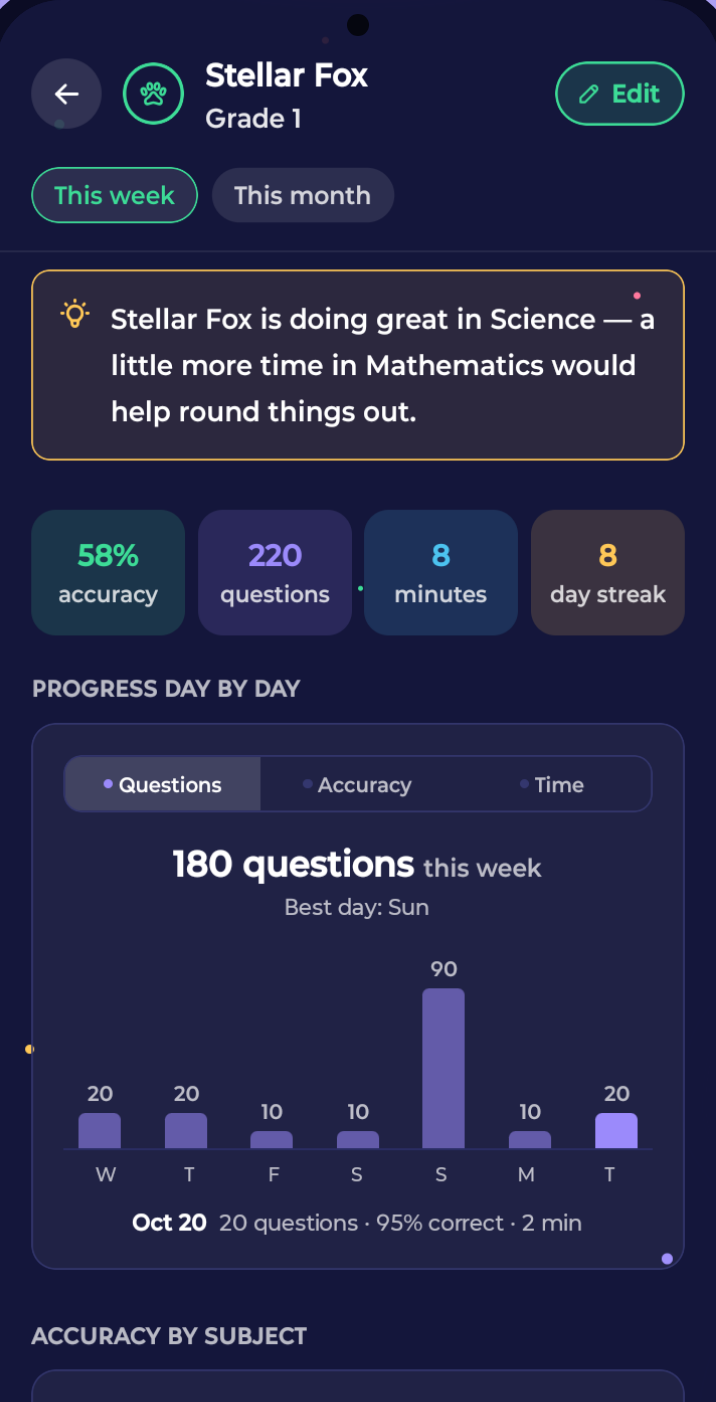
These questions come from the Brain & Bounce Kids question bank. In the app, your child gets five minutes of Computer practice a day at the right level for Class 5, an explanation after every answer, and a Parent Zone that shows which topics need work.
Frequently asked questions
- What topics are covered in Class 5 Computer?
- Brain & Bounce Kids covers 10 topics in Class 5 Computer: Computer Fundamentals (Advanced), Hardware, Software & Memory, Input, Output & Storage Systems, Files, Folders & Data Management, Algorithms & Flowcharts (Advanced), Coding Concepts (Sequence, Loops, Logic), Conditional Logic (If–Else & Decisions), Block-Based Coding (Advanced), Internet, Communication & Digital Tools, Cyber Safety & Digital Citizenship.
- Are these Class 5 Computer questions useful for Olympiads?
- Yes. The NCO (National Cyber Olympiad) covers computer basics, internet safety and reasoning, which are the same areas practised here.
- How much Computer practice does a Class 5 child need each day?
- Five to ten minutes a day is enough for most children in Classes 1–5. Short, regular practice with an explanation after each mistake works better than a long session once a week.
- practice-questions
- class-5
- computer